Tuesday, 16 October 2012

D.W.Griffith's "Birth of the Nation" (1915)


Write a review on the film with relevant screen shots;

- Topic/Area of review;


1. Editing continuity

                   Tempo and spatial continuity as a way of advancing narrative, using such techniques as 180 degree rule, establishing shot and shot reverse shot. It can be show in the video below about woman throw herself off the cliff. Now commonplace in film editing, Griffith used this to keep the storyline flow easily, move naturally with the action of the scene.
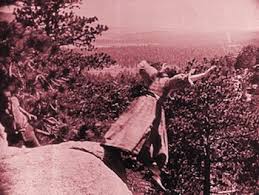


                                                      woman throw herself off cliff


2. Titles


3. Settings


4. Costumes


5. Props


6. Story Structure

Major Conflict - Carpetbaggers, thieves, and muckrakers from the North descend greedily upon the South after the postwar assassination of President Lincoln to defile the honored traditions of its aristocratic gentry by raising black militias to take power over the land.

Rising Action -  The opportunism of Austin Stoneman, the lusty cruelty of Silas Lynch, and the criminal behavior of the newly freed black slaves threaten Southern whites, who seethe amid the danger and try to find a solution.

Climax - At the moment when Ben Cameron suffers his worst bout of agony and hopelessness over his lost land, inspiration comes to him to form the Ku Klux Klan, providing him and the rest of the South a way to fight back.

Falling Action - As soon as the Klan forms, Ben Cameron leads the group through Piedmont, rescuing all whites in danger, violently punishing misbehaving blacks, and wresting control of the land back into the hands of the Southern whites.


7. Impact

Political-

Economical-

Social-

Technology-

D.W. Griffith's "Intolerance" (1916) - In an attempt to make up for the accusations of being a racist that were levied againts him after "The Birth Of A Nation", Griffith set out to tell 4 parallel stories about man's inhumanity to man: each one taking place in a different time of history. He brings all 4 stories to a simultaneous climax and ends them with a vision of religous rapture.


1. What are the 4 stories?
2. What is a story?
     - provide evidence
3. What is the plot?
            
  • THE 'MODERN' STORY (A.D. 1914): In early 20th century America during a time of labor unrest, strikes, and social change in California and ruthless employers and reformers - a young Irish Catholic boy, an exploited worker, is wrongly imprisoned for murder and sentenced to be hung on a gallows. The boy is saved from execution in a last-minute rescue by his wife's arrival with the governor's pardon.
  • THE JUDAEAN STORY (A.D. 27): The Nazarene's (Christ's) Judaea at the time of his struggles with the Pharisees, his betrayal and crucifixion (told as a Passion Play in his last days) - it is the shortest of the four stories.
  • THE FRENCH STORY (A.D. 1572): Renaissance, 16th century medieval France at the time of the persecution and slaughter of the Huguenots during the regime of Catholic Catherine de Medici and her son King Charles IX of France, and the notorious atrocities of St. Bartholomew's Day Massacre (including its effects upon the planned wedding of a young innocent Huguenot couple - Brown Eyes and Prosper Latour).
  • THE BABYLONIAN STORY (539 B.C.): Peace-loving Prince Belshazzar's Babylon at the time of its Siege and Fall by King Cyrus the Persian, due to the treacherous High Priests - and the Mountain Girl's vain efforts to avert the tragedy. The outdoor set for the Babylonian sequences was the largest ever created for a Hollywood film up to its time, and its crowd shots with 16,000 extras were also some of the greatest in cinematic history.

          In his radically non-linear, hybrid film, Griffith simultaneously cross-cuts back and forth and interweaves the segments over great gaps of space and time - there are over 50 transitions between the segments. The villains of the four stories are mill owner Jenkins and his intolerant social reformers, the hypocritical Pharisees - opponents of Christ, the evil regime of the cunning Queen Catherine, and the treacherous High Priest of Babylon. Their powerful actions set in motion disturbing consequences for a modern-day working-class couple, for an average French Huguenot family and its soon-to-be-betrothed daughter Brown Eyes, for the Nazarene/Christ, and for the enlightened, revolutionary and benevolent Prince Belshazzar.
         The symbolic bridging device that interconnects and links together the various stories is the recurring cameo shot of Lillian Gish, his greatest star, as Eternal Motherhood. She endlessly and eternally rocks a cradle, accompanied by the title from Walt Whitman's poem Leaves of Grass: "Out of the Cradle Endlessly Rocking. Uniter of Here and Hereafter - Chanter of Sorrows and Joys." Her iconic image, rocking the cradle of humanity, serves as a symbol of continuity for the entire history of the human race, and a representation of the cycle of life and death.


Tuesday, 2 October 2012

What were Edwin S. Porter's contribution(s) to the invention of the motion picture?


               Edwin S. Porter perfected a number of techniques that became standard film practice, including the close-up of an actor's face and the dissolved from one scene to the next. Both of this techniques which were borrowed from the early magic lantern shows that predated cinema, became hallmarks of the Edison studios. Magic lantern shows features slides that portrayed famous people. Dissolving from one slide to slide was a common way for exhibitors to move through a particular program. Once the projector was introduced, however, these techniques became virtually impossible for the exhibitor to execute. Porter's ability to import these techniques into the film itself established a new creative authority for the filmmaker at the same time that it reintroduced familiar forms to American audiences.
                   Porter also contributed to film ‘actualities’, a kind of precursor to today’s documentary, or non-fiction film. When President McKinley was assassinated in 1901, Porter filmed his funeral procession in Buffalo, New York. The film consisted of 4 separate films that were connected by a series of dissolves. One of Porter’s more startling actualities was the multi-shot Execution of Czolgosz with Panorama of Auburn Prison in which a start series of shots depicting the execution of McKinley’s assassin in preceded and followed by panoramic shots of the prison grounds.


            Porter continued to develop his film editing techniques in his best known and most popular film, The Great Train Robbery. On its most simplistic level, the film is a story of crime, pursuit, and capture. But it is perhaps the first great American chase film, a form still popular today. Again Porter edited his film using cross-cutting to show events that were supposedly occurring at the same time: the bandits begin their escape while the posse organizes a pursuit. The Great Train Robbery was an enormously popular film at a time when nickelodeons were just opening across the country, and the film did a great deal of repeat business.

Monday, 1 October 2012

What were D.W.Griffith's contribution(s) to the invention of motion picture?


            David Wark Griffith’s films became part of history in the making—unleashing the power of movies as a catalyst for social change. More than anyone of the silent era, he saw film’s potential as an expressive medium, and exploited that potential. Griffith's contributions to Hollywood filmmaking combined both film content and camera style which would change the way future directors created their own films. From developing and expanding new techniques including crosscutting, close-ups, and camera movement, to his advancement of film content using parallel story lines, and enhanced complex narratives, D.W. Griffith lifted the bar of film creation to heights never seen before on the screen.