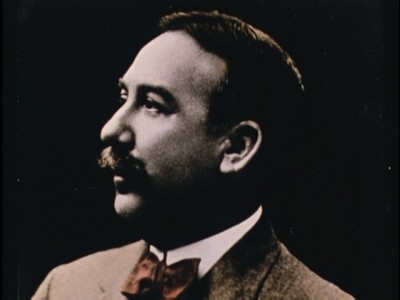
Edwin S. Porter perfected a number of techniques that became standard film practice, including the close-up of an actor's face and the dissolved from one scene to the next. Both of this techniques which were borrowed from the early magic lantern shows that predated cinema, became hallmarks of the Edison studios. Magic lantern shows features slides that portrayed famous people. Dissolving from one slide to slide was a common way for exhibitors to move through a particular program. Once the projector was introduced, however, these techniques became virtually impossible for the exhibitor to execute. Porter's ability to import these techniques into the film itself established a new creative authority for the filmmaker at the same time that it reintroduced familiar forms to American audiences.
Porter
also contributed to film ‘actualities’, a kind of precursor to today’s
documentary, or non-fiction film. When President McKinley was assassinated in
1901, Porter filmed his funeral procession in Buffalo, New York. The film
consisted of 4 separate films that were connected by a series of dissolves. One
of Porter’s more startling actualities was the multi-shot Execution of Czolgosz with Panorama of Auburn Prison in which a
start series of shots depicting the execution of McKinley’s assassin in
preceded and followed by panoramic shots of the prison grounds.

Porter continued to develop his film editing techniques in his best known and most popular film, The Great Train Robbery. On its most simplistic level, the film is a story of crime,
pursuit, and capture. But it is perhaps the first great American chase film, a
form still popular today. Again Porter edited his film using cross-cutting to
show events that were supposedly occurring at the same time: the bandits begin
their escape while the posse organizes a pursuit. The Great Train Robbery was an enormously popular film at a time when nickelodeons
were just opening across the country, and the film did a great deal of repeat
business.

No comments:
Post a Comment